⏳ This skill is pending AI review.
Scores will appear once the review pipeline completes.
impl-gh-issue
Implement an AccessFlow GitHub issue end-to-end — fetch with gh, plan against docs/, follow CLAUDE.md conventions, update tests and docs, then open a PR. Trigger when the user says "implement issue #N", "work on AF-N / FE-N", or passes a GitHub issue URL/number.
Choose how to use this skill
You do not need every option. Choose the path your AI client supports. The stable page stays the same; versioned files are immutable.
1. Native installer
This listing has no registered native installer command. Use the complete package or source fallback below, depending on what your client supports.
Do not guess an installer command or replace an existing version without reviewing the diff.
2. Complete package recommended
Download the ZIP when available. It includes SKILL.md plus the references, security notes and version metadata.
No complete ProSkills package is published for this listing yet.3. Prompt-only
Copy the prompt above when the agent can read the stable page or when you want to adopt the workflow without installing a skill.
Need only the instruction file?
Download SKILL.md only if your client requires a single file. The complete ZIP is safer for a full installation because it preserves the references and release context.
No path installs or executes anything by itself. Your agent still needs access to the project files. Before updating, compare the installed version and review the diff.
// RATINGS
Not yet listed on ClawHub or SkillsMP
// README
AccessFlow sits as a full query proxy in front of your databases — the relational engines PostgreSQL, MySQL, MariaDB, Oracle, and Microsoft SQL Server are supported out of the box via a declarative connector catalog (additional engines such as ClickHouse install with one click), any other JDBC-compatible engine can be added by uploading its driver JAR, the NoSQL document engines MongoDB and Couchbase (SQL++), the NoSQL key-value engine Redis, the NoSQL wide-column engines Apache Cassandra (CQL) and ScyllaDB (CQL-compatible), the NoSQL search engines Elasticsearch and OpenSearch, the NoSQL key-value engine Amazon DynamoDB (PartiQL), the NoSQL graph engine Neo4j (Cypher over Bolt), and the cloud data warehouses Snowflake, Google BigQuery (GoogleSQL), and Databricks SQL install the same way through on-demand native engine plugins. The catalog separates the SQL (relational) family, the cloud data-warehouse family, and the NoSQL umbrella of native engine-managed connectors. Every query a user submits — SQL, a MongoDB shell / JSON command, a Couchbase SQL++ statement, a Redis command, a Cassandra/ScyllaDB CQL statement, an Elasticsearch/OpenSearch query, a DynamoDB PartiQL statement, a Neo4j Cypher statement, or a Snowflake / BigQuery / Databricks warehouse SQL statement — is parsed, classified, optionally analyzed by AI, and routed through a configurable human-approval workflow before it ever reaches live data. The same governance extends beyond databases: outbound REST, SOAP, GraphQL, and gRPC calls against registered API connectors run through that identical pipeline — AI risk scoring, attribute-based routing, multi-stage approval — with response masking and immutable, downloadable response snapshots. Every request, decision, and execution is captured in a tamper-evident metadata audit log. Authentication is JWT (RS256) with optional SAML 2.0 SSO and OAuth 2.0 / OIDC sign-in (built-in templates for Google, GitHub, GitHub Enterprise Server, Microsoft, GitLab, and self-managed GitLab), and SCIM 2.0 provisioning lets the identity provider drive user & group lifecycle end to end. AccessFlow ships as a single open-source product under Apache 2.0 and is designed to run entirely inside your own infrastructure.
Why AccessFlow
Most teams pick one of two extremes for database access:
- Shared production credentials — anyone with the password can run
DELETE. Fast, but a single mistake is unbounded and there is no record of who did what. - Ticket-driven DBA access — every change goes through a manual DBA queue. Safe, but slow enough that engineers route around it.
AccessFlow provides the missing middle: governed, self-service access where every query is reviewable, every approval is traceable, and AI catches the obvious problems before a human ever sees the request.
See it in action
A glance at the day-to-day flows engineers and approvers actually use.
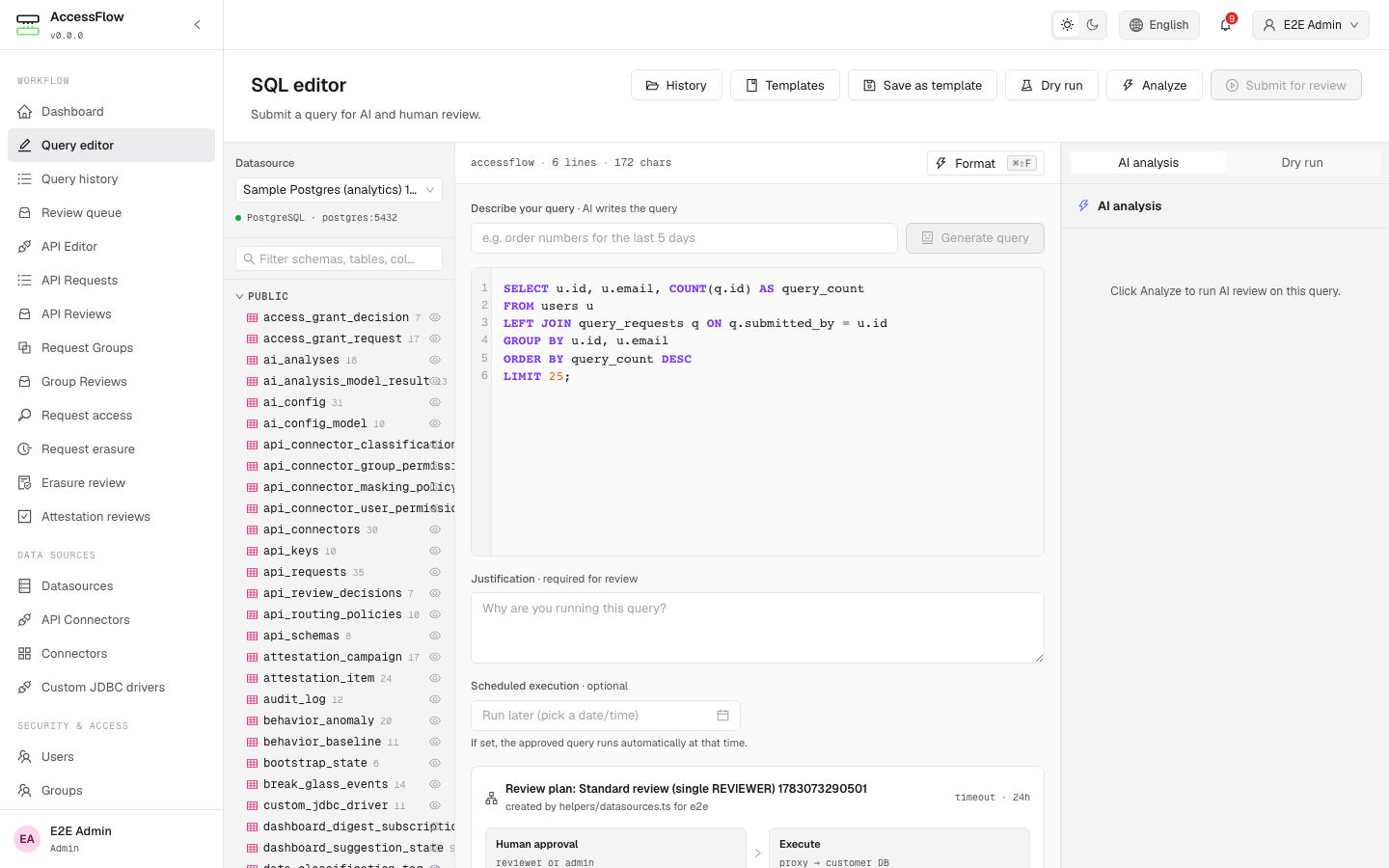
Submit a query — CodeMirror 6 with dialect-aware highlighting, live schema autocomplete, and an inline review-plan preview that shows exactly which approvals the submission will trigger.
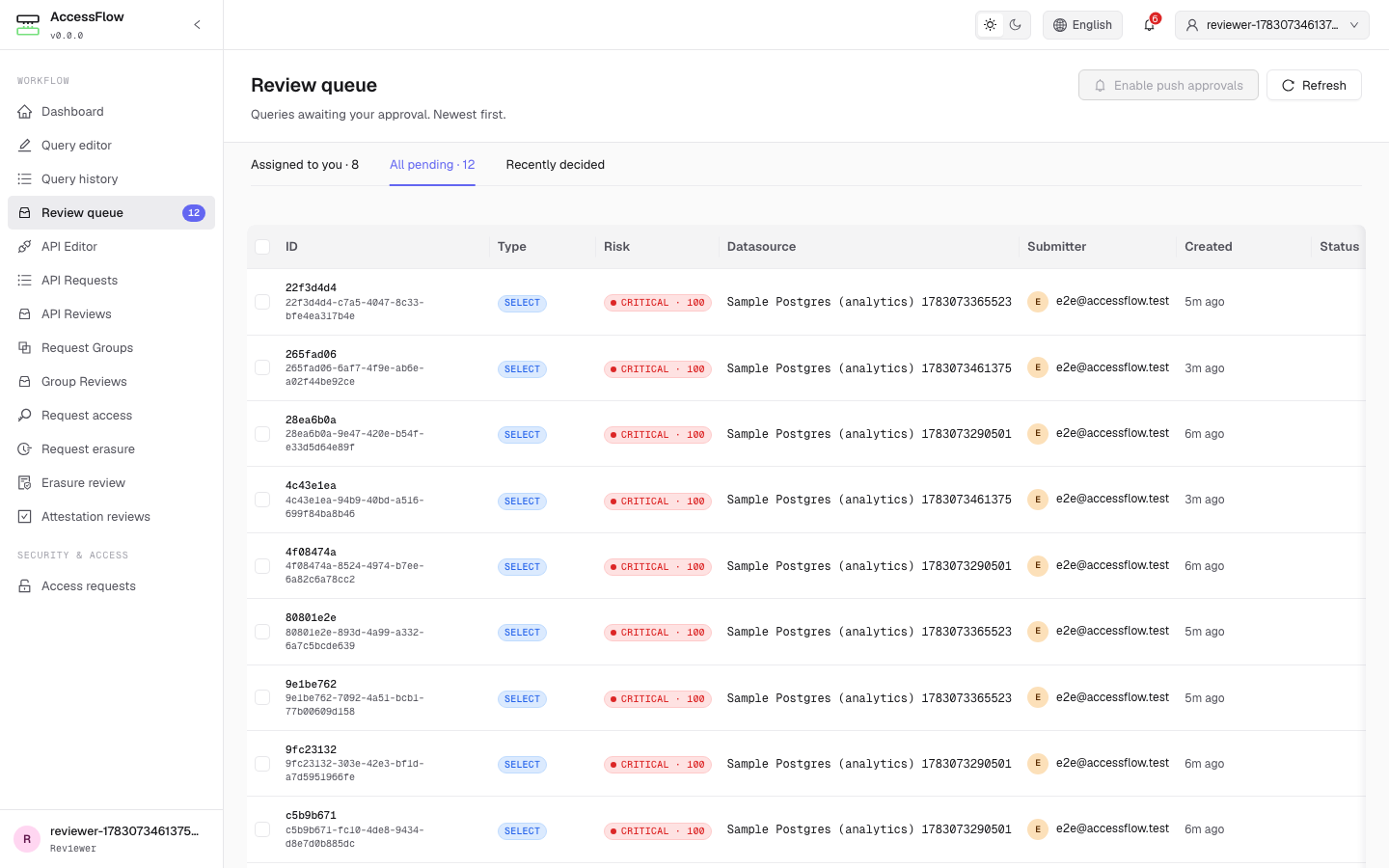
Approve or reject pending writes from one place — the queue is scoped to queries assigned to you, with risk score, query type, and submitter at a glance. A user can never approve their own query.
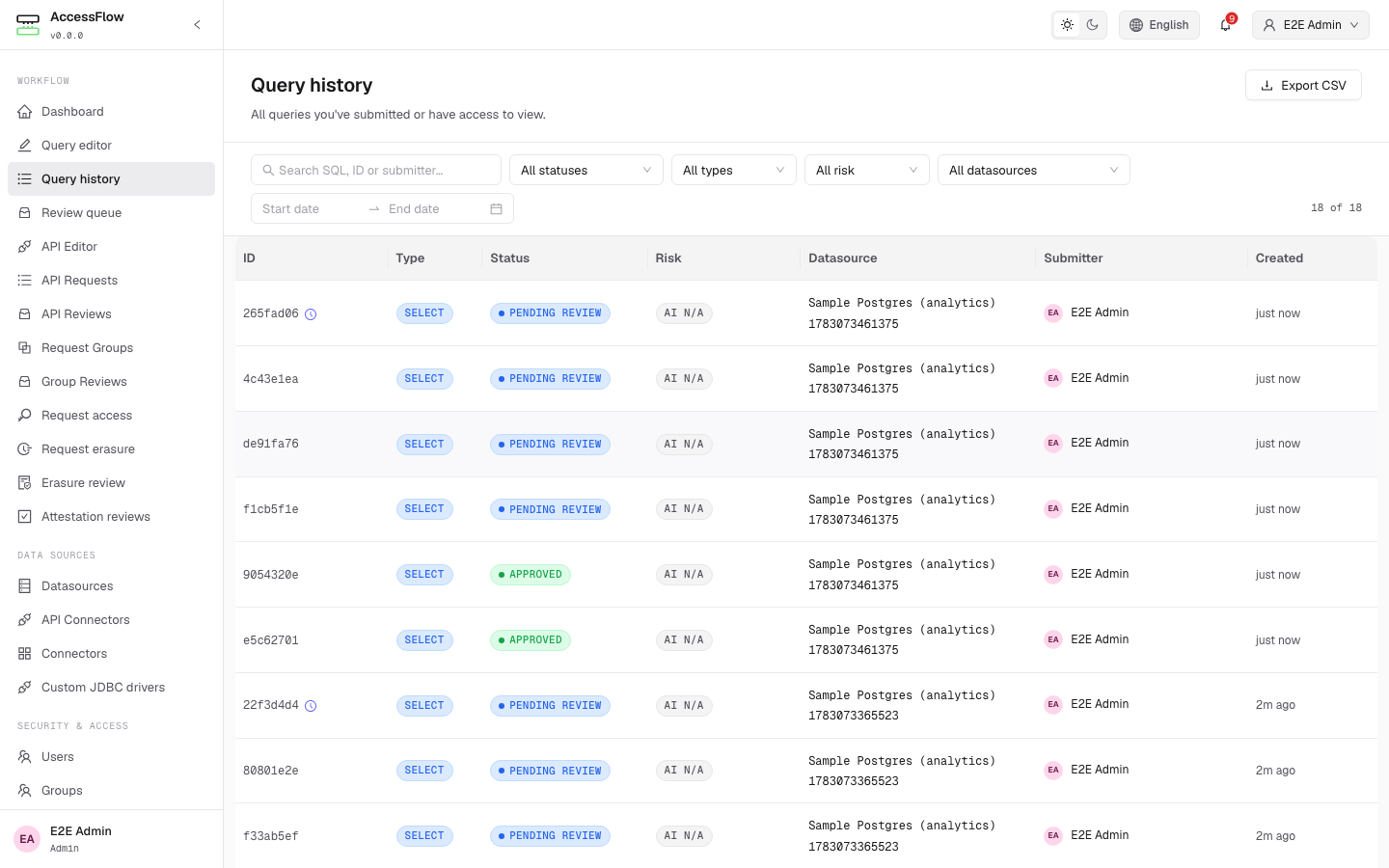
Searchable, filterable history of every query — by status, type, risk, datasource, submitter, or date range — with CSV export. Each row links to the full request, AI analysis, approval timeline, and result set.
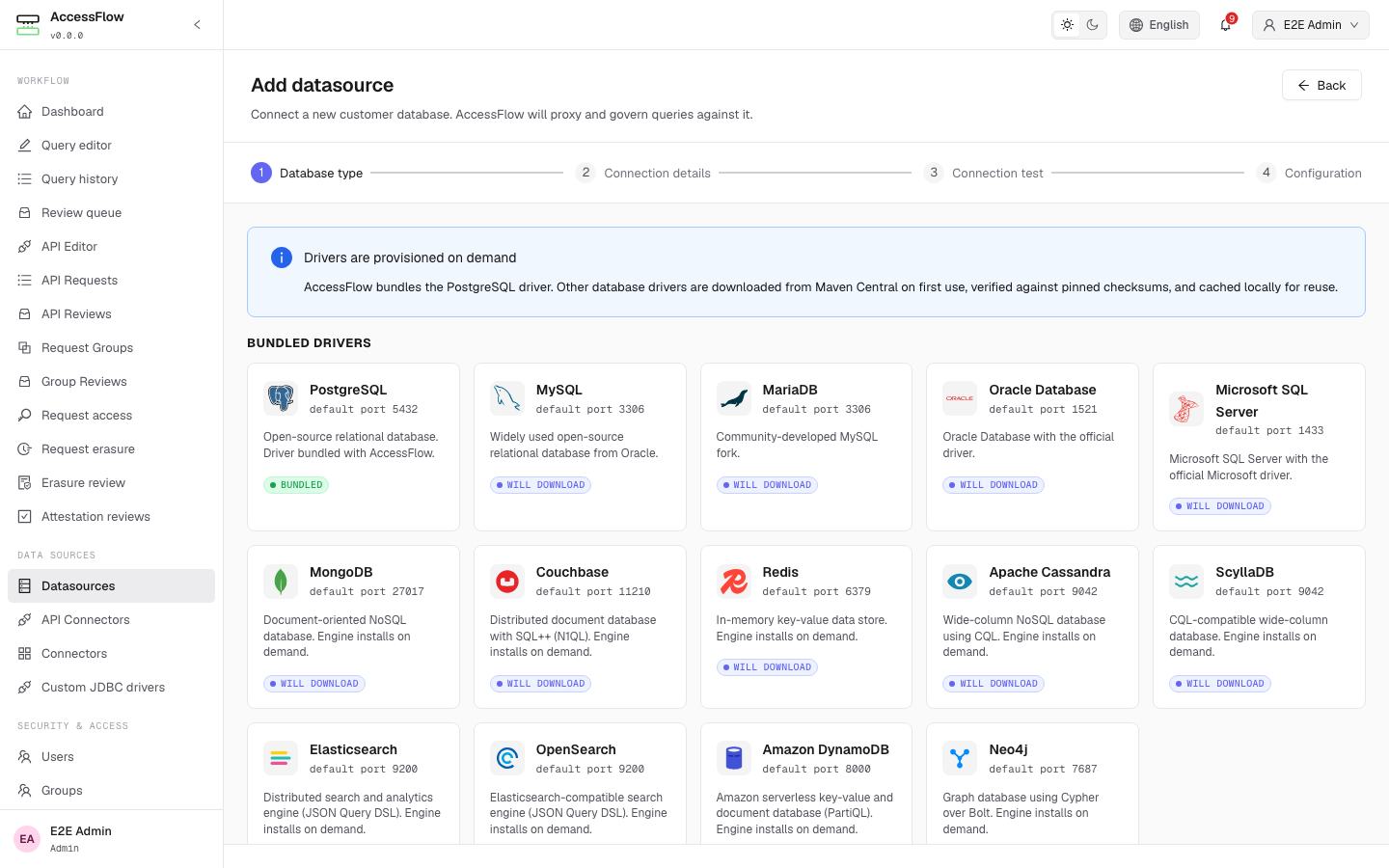
Connect a database in the admin UI — credentials are AES-256-GCM encrypted at rest, the proxy holds them, and end users never see them.
More walkthroughs — the Guides section carries step-by-step manuals for the setup tasks: your first governed query, adding a datasource, notifications and SMTP, users and roles, single sign-on, AI risk analysis, outbound API calls, gating a CI/CD pipeline, Terraform and the in-app help assistant — which, once enabled, answers all of the above from inside the app. Review plans, AI provider configuration, notification channels (Email, Slack, Discord, Telegram, Teams, PagerDuty, ServiceNow, Jira, webhooks), OAuth 2.0 / OIDC sign-in, SAML 2.0 SSO, users & invitations, and system SMTP each have their own reference chapter with screenshots on the public documentation site.
Features
- Proxy-first execution — no user ever holds production credentials; the proxy holds them encrypted and opens connections only after approval. Single SQL statements run with autocommit; multi-statement INSERT/UPDATE/DELETE batches wrapped in
BEGIN; … COMMIT;execute atomically inside one JDBC transaction (mixed SELECT/DML batches are rejected at parse time), with homogeneous INSERT runs collapsed into JDBCexecuteBatch()for bulk-load throughput. Optional multi-replica read load balancing: attach any number of replica endpoints to a datasource and SELECT traffic round-robins across the healthy ones — per-node health checks with circuit-breaker failover skip downed replicas, and only full replica-set exhaustion falls back to the primary (with an audit row). Optional SELECT result caching: opt a datasource into a Redis-backed result cache (per-datasource TTL) keyed over the security-rewritten query — masking and row-level security still apply — and invalidated on any proxied write to a referenced table. - Configurable review workflows — per-dat
// HOW IT'S BUILT
KEY FILES