⏳ This skill is pending AI review.
Scores will appear once the review pipeline completes.
melonjs-3d
Use this skill for anything 3D or 2.5D in melonJS — Camera3d, Mesh, InstancedMesh, Sprite3d billboards, Light3d, ground shadows, glTF/GLB scenes, and depth sorting. Covers the Y-down/+Z-forward convention that is the inverse of OpenGL, the cameraClass opt-in, clip planes, and what does not work on the Canvas fallback. Triggers on: Camera3d, Mesh, InstancedMesh, Sprite3d, Trail3d, ribbon, exhaust trail, Light3d, billboard, glTF, glb, 3D, 2.5D, depth, cameraClass, fov, setClipPlanes, setFog, fog, distance fog, height fog, heightFalloff, transparent, transparency, alpha, blendMode, fade, castGroundShadow, lit, setBasis, getBasis, lookAt, up vector, gimbal, slerp, great circle, turn a direction.
Choose how to use this skill
You do not need every option. Choose the path your AI client supports. The stable page stays the same; versioned files are immutable.
1. Native installer
This listing has no registered native installer command. Use the complete package or source fallback below, depending on what your client supports.
Do not guess an installer command or replace an existing version without reviewing the diff.
2. Complete package recommended
Download the ZIP when available. It includes SKILL.md plus the references, security notes and version metadata.
No complete ProSkills package is published for this listing yet.3. Prompt-only
Copy the prompt above when the agent can read the stable page or when you want to adopt the workflow without installing a skill.
Need only the instruction file?
Download SKILL.md only if your client requires a single file. The complete ZIP is safer for a full installation because it preserves the references and release context.
No path installs or executes anything by itself. Your agent still needs access to the project files. Before updating, compare the installed version and review the diff.
// RATINGS
Not yet listed on ClawHub or SkillsMP
// README
melonJS 2







A modern & fully featured HTML5 game engine
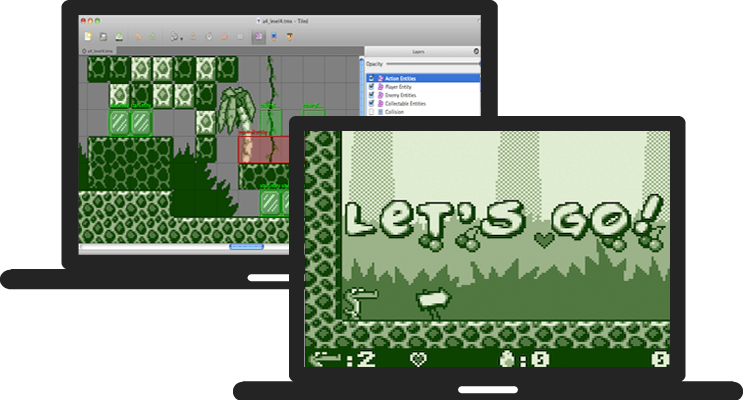
melonJS is an open-source 2.5D game engine designed for indie developers — perspective and orthogonal cameras, GPU-accelerated tilemap rendering, post-processing effects, custom shaders, 3D mesh support, polygon-accurate physics, modern Tiled workflows, and high performance. Runs on WebGPU, WebGL 2 or Canvas2D with automatic fallback. The whole engine is ~250 KB minzipped of vanilla JS/TS, with no dependencies and no toolchain lock-in. Built with modern class syntax and bundled with esbuild.
melonJS is licensed under the MIT License and actively maintained by the team at AltByte in Singapore.
Why melonJS
melonJS is designed so you can focus on making games, not on graphics plumbing.
-
Canvas2D-inspired rendering API — If you've used the HTML5 Canvas, you already know melonJS. The rendering API (
save,restore,translate,rotate,setColor,fillRect, ...) follows the same familiar patterns — no render graphs, no shader pipelines, no instruction sets to learn. -
True renderer abstraction — Write your game once, run it on WebGPU, WebGL 2 or Canvas2D with zero code changes. The engine handles all GPU complexity behind a unified API: the default
AUTOmode tries WebGPU first at startup, falls back to WebGL 2 if that is unavailable, and ultimately to Canvas, and the entire feature set renders identically on both GPU backends. -
Complete engine, minimal footprint — Physics, tilemaps, audio, input, cameras, tweens, particles, UI — a full game stack in a single tree-shakeable ES module. No dependency sprawl, no library stitching.
-
Scenes, loaded in one call —
level.load(name)brings an authored scene straight into your world. Tiled is a first-class citizen for 2D — orthogonal, isometric, hexagonal & staggered maps, animated tilesets, collision shapes, object properties, compressed formats, with GPU-accelerated tile rendering on the GPU backends — and glTF / GLB is the equivalent for 3D scenes: author in Blender (or any DCC tool), export a.glb, and the whole scene — meshes, materials, cameras, lights, and node animation — loads under aCamera3d, no per-mesh wiring. Animated models play back through the same animation API as a 2DSprite. -
Batteries included, hackable by design — Get started in minutes with minimal setup. When you need to go deeper: modern class-based architecture, a plugin system for engine extensions, and a clean architecture that's easy to extend without fighting the framework.
About melonJS
melonJS is a fully featured game engine :
Compatibility
- Standalone library (does not rely on anything else, except a HTML5 capable browser)
- Compatible with all major browsers (Chrome, Safari, Firefox, Opera, Edge) and mobile devices
Graphics
- Fast GPU renderers (WebGPU and WebGL 2) for desktop and mobile devices, with fallback to Canvas rendering
- Since 20.0 the aging WebGL 1 path is retired and WebGL 2 is the baseline; devices offering only WebGL 1 fall back to the Canvas renderer under
AUTO - Extensible batcher system for custom rendering pipelines, with backend-neutral vertex formats and draw topologies (declare a layout once, describe it to either GPU backend)
- High DPI resolution & Canvas advanced auto scaling
- Sprite with 9-slice scaling option and frame animation
- Built-in effects such as tinting, masking, and the full set of CSS-style blend modes (normal, none, additive, multiply, screen, exclusion, darken, lighten, overlay, hard-light, color-dodge, color-burn, soft-light, difference) — all of them supported identically on WebGPU, WebGL 2 and Canvas since 20.2
- Standard spritesheet, single and multiple Packed Textures support
- Compressed texture support (DDS, KTX, KTX2, PVR, PKM) with automatic format detection and fallback
- Hardware antialiasing (
antiAlias: true) on both GPU backends — and it survives post-processing, since the offscreen targets a post-effect chain renders into are multisampled to match - Procedural noise textures:
Noise(simplex/perlin/value/cellular, fBm / ridged / ping-pong fractal, domain warp; renderer-free and CPU-samplable for heightmaps, terrain, and spawn jitter) andNoiseTexture2d— bake a noise field into a sprite image, aGradientcolor ramp, or a live-animated tangent-space normal map for lit water and surfaces; unified under a newTexture2dbase alongsideTextureAtlas - 3D mesh rendering with OBJ/MTL model loading, multi-material support, hardware depth testing, and perspective projection via
Camera3d— retained-mode geometry, uploaded to the GPU once and re-drawn from there, so moving, rotating, scaling or re-tinting a mesh costs no vertex upload and no per-vertex CPU work at all - Mipmapped and anisotropically-filtered mesh textures on both GPU backends, so distant and grazing-angle geometry stops shimmering (opt out per mesh with
textureFilter: "nearest"for crisp pixel-art models) - Lighting, in 2D and 3D:
- 2D —
Light2das a first-classRenderable(multiple dynamic lights, radial-gradient falloff, illumination-only mode, procedural rendering viadrawLight), plus optional per-pixel normal-map shading on sprites for 3D-looking dynamic lights - 3D —
Light3ddirectional, point, spot and ambient lights, added to the world likeLight2d(half-Lambert diffuse + ambient fill, quadratic falloff and cone angles on the punctual types, runtime-manipulable for day/night), auto-loaded from a glTF scene's authored suns and lamps - up to 32 simultaneous lights on either path, with light data travelling in a uniform buffer — a static light rig costs zero GPU state changes per frame
- 2D —
- Ground ("blob") shadows for 3D objects — on by default — so characters and props read as standing on the floor instead of hovering. An ellipse matching the caster's own footprint and rotation, shrinking and fading with height above the ground; one extra draw per object, and one for an entire
InstancedMeshscatter regardless of instance count. Shaped by the light rather than always straight down:shadowLightpoints a blob at aLight3dand is re-read every draw, so a day/night cycle carries every shadow with it, whileshadowOffsetslides it out from the caster's feet,shadowStretchlengthens it for a low sun,shadowScalesizes it independently of the object, andshadowGroundNormallays it on a floor that is not level. All of
// HOW IT'S BUILT
KEY FILES