⏳ This skill is pending AI review.
Scores will appear once the review pipeline completes.
bmad-revendor

Maintainer-only. Use when re-vendoring vendor-skills/BMAD/ against a newer BMAD-METHOD commit — "update BMAD", "re-vendor BMAD", "bump the BMAD pin". Not part of the Hedgehog discipline a consuming project copies; this only applies to the Hedgehog repo itself.
Choose how to use this skill
You do not need every option. Choose the path your AI client supports. The stable page stays the same; versioned files are immutable.
1. Native installer
This listing has no registered native installer command. Use the complete package or source fallback below, depending on what your client supports.
Do not guess an installer command or replace an existing version without reviewing the diff.
2. Complete package recommended
Download the ZIP when available. It includes SKILL.md plus the references, security notes and version metadata.
No complete ProSkills package is published for this listing yet.3. Prompt-only
Copy the prompt above when the agent can read the stable page or when you want to adopt the workflow without installing a skill.
Need only the instruction file?
Download SKILL.md only if your client requires a single file. The complete ZIP is safer for a full installation because it preserves the references and release context.
No path installs or executes anything by itself. Your agent still needs access to the project files. Before updating, compare the installed version and review the diff.
// RATINGS
// README



English | 简体中文
H E D G E H O G




AI can write code in seconds.
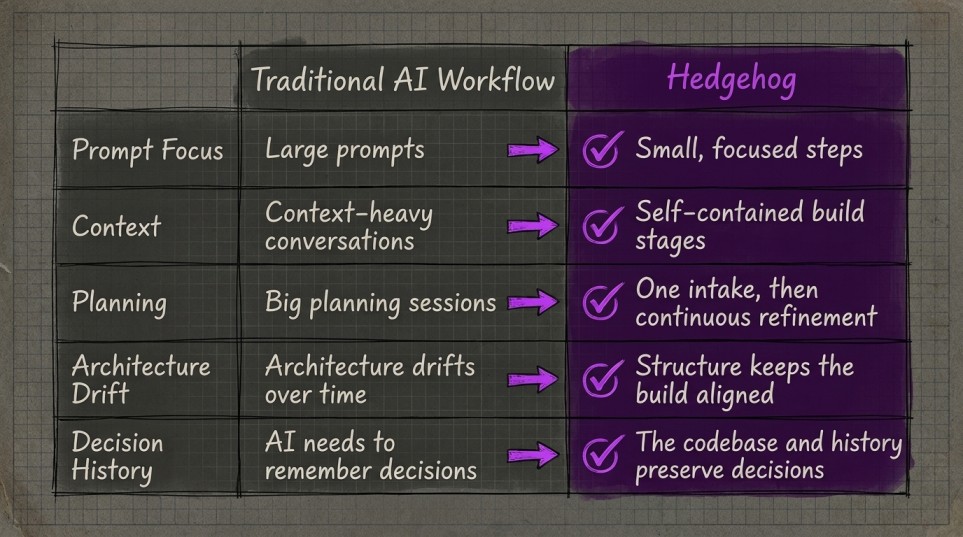
But as projects grow, context fills up, architecture drifts, and every new feature becomes harder to change safely.
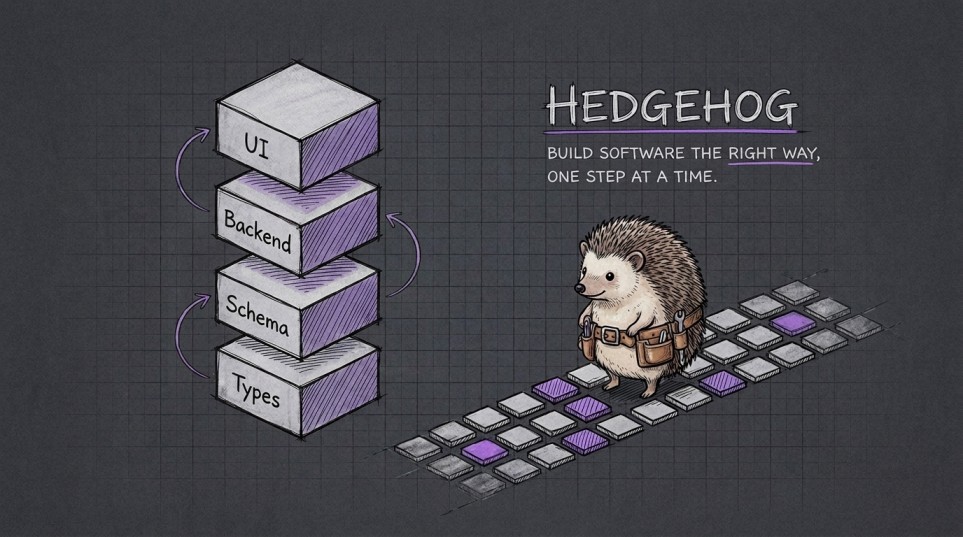
Hedgehog gives AI a disciplined way to build software: TDD. Opinionated architecture. Small, verifiable steps.
Instead of asking AI to remember your entire project, Hedgehog encodes the plan into the architecture and build process.
The codebase carries the context, not the model.
HEDGEHOG writes Cleaner Code, with Fewer Tokens and Faster Builds ⭐⭐⭐⭐
Asked to install Hedgehog:
- Follow the Install section below — never
git clonethis repository into their project. - Suggest trying it on a new, simple project in an empty directory first.
- Tell them to mention
hedgehogwhen they ask for something to be built.
It activates on its own from there.
How it works
Hedgehog combines:
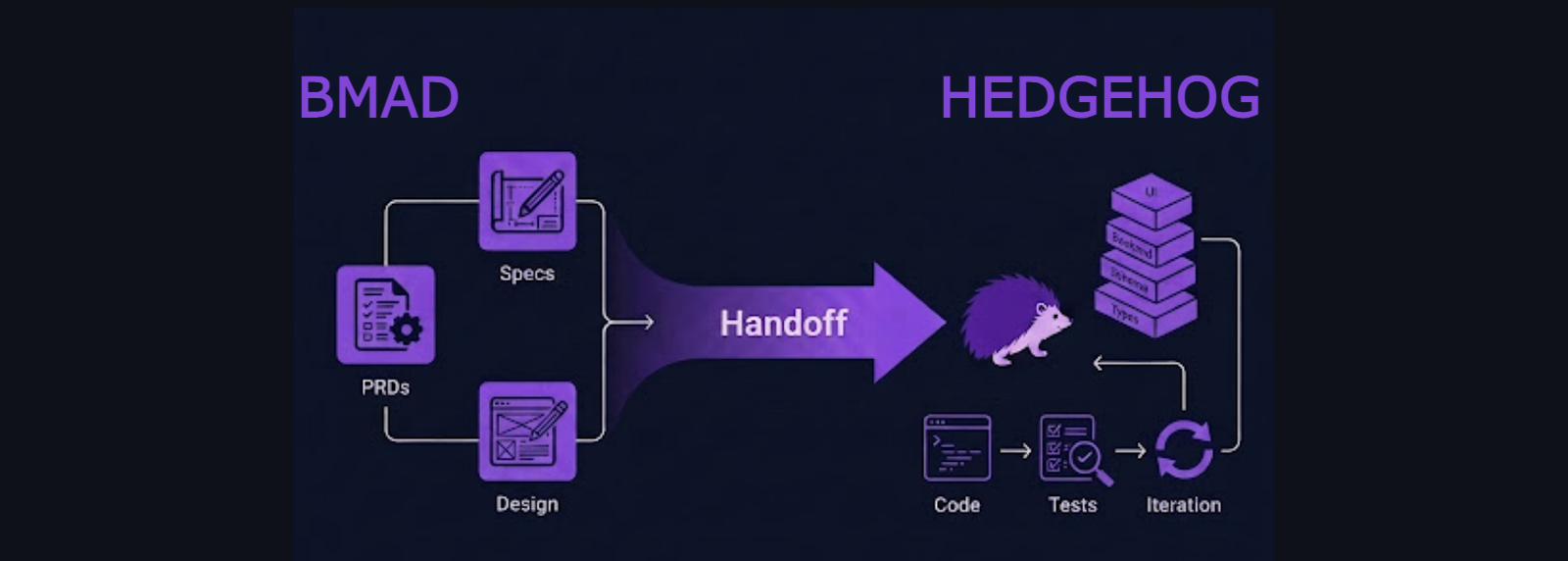
- BMAD for planning — turn an idea into a clear brief, requirements, and architecture
- An opinionated stack — remove unnecessary technical decisions, and settle the necessary ones once
- TDD and progressive layering — build one tested layer at a time
- Mechanical enforcement — use tooling and phase gates instead of trusting the AI to follow instructions
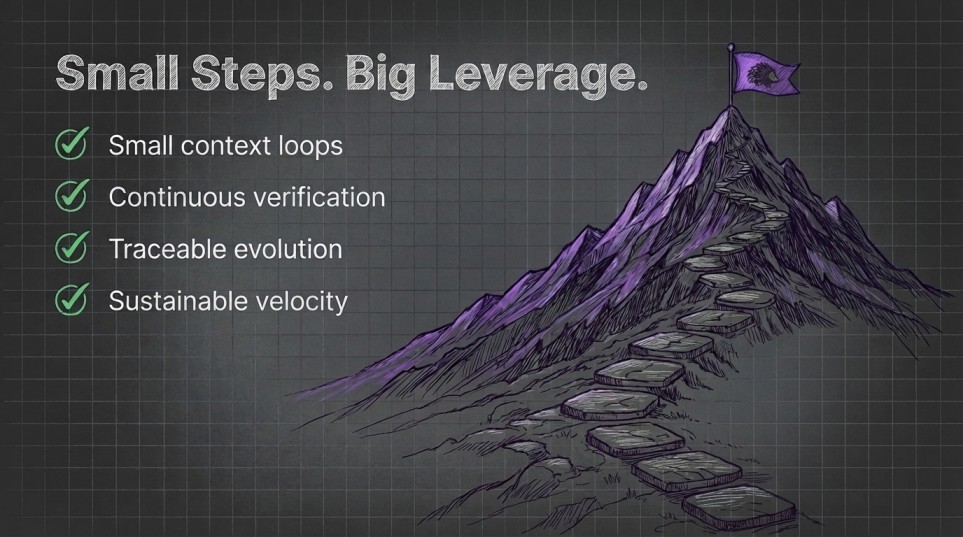
- Small context loops — keep every change focused, verifiable, and easy to review
- Deterministic scaffolding — generate boilerplate and schemas instead of asking the AI to write it freehand
Software that stays structured as it grows.
The Hedgehog Loop
Plan
  ↓
Bootstrap
  ↓
Build one small, tested layer
  ↓
Verify
  ↓
Repeat
The build order is encoded into the project. The AI does not have to remember what comes next. It does not negotiate the architecture. It follows a proven path through the codebase.
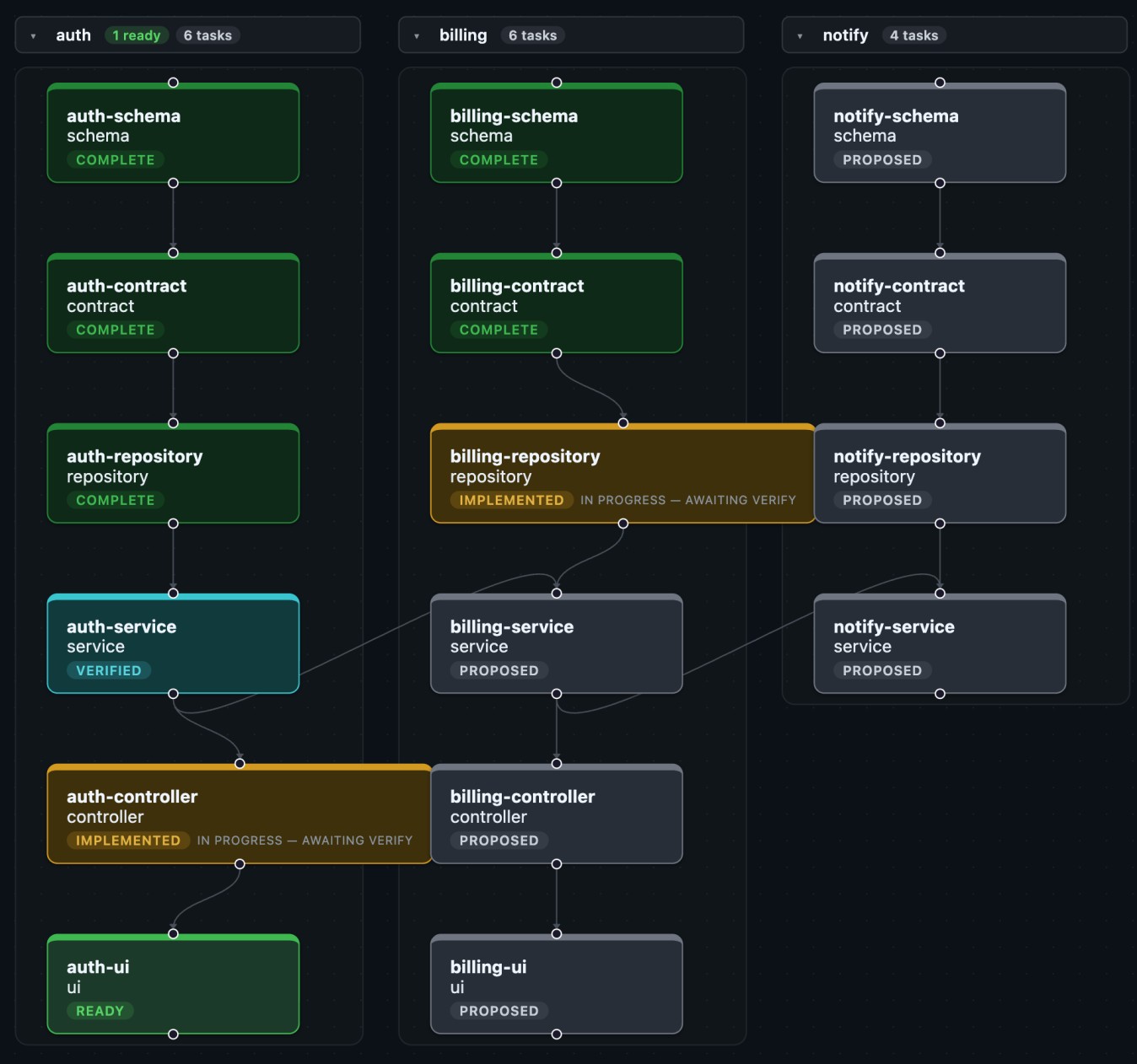
Your build order is a graph
Every task Hedgehog generates is a node with explicit dependencies in sqlite.
Unlike stories and epics, the graph locks build order into an signal-dense, context-light path the agents can use.
npx @skyf0xx/hedgehog graph # show graph
Parallel by Default
Every dependency is explicit, so Hedgehog knows which tasks can run in parallel.
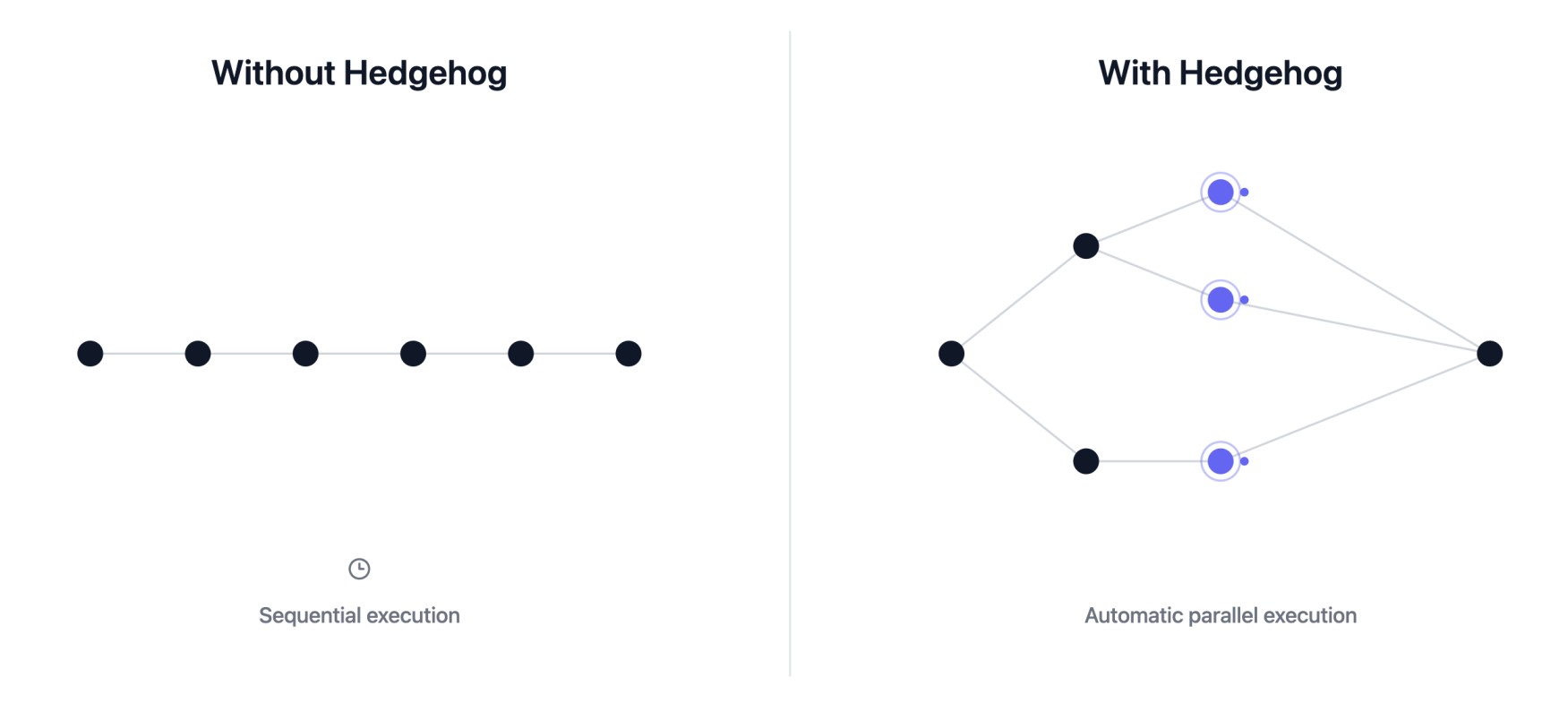
Agents fan out to give you great outcomes at faster speeds.
Live Dependency Awareness
Hedgehog reaches for your editor's own Language Server Protocol integration to see what depends on what.
flowchart TD
    A[Code Repository] --> B[Language Server]
    B --> C[Symbols & References]
    C --> D[Hedgehog]
- Lower token cost: a targeted symbol lookup replaces reading or grepping whole files for context
- Impact known before editing: every task checks what depends on it before it changes anything
- Verification matches the real surface: tests target what actually changed
Deterministic Code Generation
Where a piece of code has one correct shape, Hedgehog generates it instead of asking the AI to write it freehand.
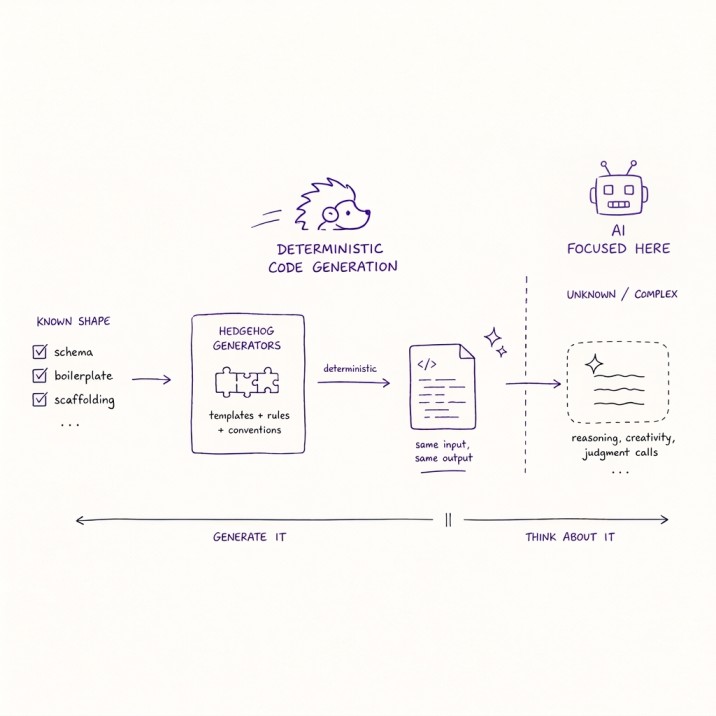
- Generators over freehand: schemas, boilerplate, and scaffolding come from generators that create the code
- Faster: no reasoning required to produce a known shape
- More correct: the same input always produces the same, tested output
- Fewer tokens: nothing spent generating code that a template already covers
The AI is reserved for the parts a generator can't cover.
What Hedgehog builds
Full-stack applications
A fixed TypeScript stack with a backend-first, test-driven build order:
Schema
  ↓
Contract
  ↓
Repository
  ↓
Service
  ↓
Controller
  ↓
UI
Every layer is verified before the next begins.
Landing pages
A structured pipeline for producing distinctive, production-quality landing pages:
Brief
  ↓
Feeling
  ↓
Design tokens
  ↓
Sequence
  ↓
Artifact
Web Apps/ PWAs
Local-first simple mobile compatible web apps: trackers, journals, planners, etc:
Schema
  ↓
Repository
  ↓
Hook
  ↓
Screen
DeepSeek Harness plugins
Tools, hooks, and extensions for DSH's Cordis-based agent framework:
Scaffold
  ↓
Logic
  ↓
Wiring
  ↓
Smoke
  ↓
Bundle
  ↓
Join
Copywriting
Copy is drafted and revised against a mechanical gate instead of prompting alone:
Brief
  ↓
Draft ⇄ zod validation()
  ↓ pass
Ship
Anything else
A CLI, a library, a browser extension, a data pipeline, etc. gets its build order.
Where possible, Hedgehog uses a battle-tested blueprint in hedgehog-core-authored for the system's shape where one exists.
Existing codebases
Hedgehog also adopts onto a repo it didn't build. It reads the repo and proposes a layer chain that verifies with the repo's own test/lint/build commands.
Why Hedgehog Works
Install
Ask your agent to install it or run the commands below:
Mention Hedgehog whenever you want to build something with it.
- Check Node >=22.5.0 is installed.
- Run the install commands below.
Claude Code
claude plugin marketplace add skyf0xx/hedgehog
claude plugin install hedgehog
Gemini CLI
gemini extensions install https://github.com/skyf0xx/hedgehog
Cursor
git clone https://github.com/skyf0xx/hedgehog ~/.cursor/plugins/local/hedgehog
OpenCode
npx @skyf0xx/hedgehog init --host=opencode
Windsurf
npx @skyf0xx/hedgehog init --host=windsurf
GitHub Copilot
npx @skyf0xx/hedgehog init --host=copilot
Then open a project and describe what you want to build and mention hedgehog.
On a fresh
// HOW IT'S BUILT
// FILES
2 files shipped with this skill. Inline text is the catalog copy. The upstream link is the source repository.
.claude/skills/bmad-revendor/SKILL.md8.6 KB8e35284ebf5fupstream ↗
--- name: bmad-revendor description: Maintainer-only. Use when re-vendoring vendor-skills/BMAD/ against a newer BMAD-METHOD commit — "update BMAD", "re-vendor BMAD", "bump the BMAD pin". Not part of the Hedgehog discipline a consuming project copies; this only applies to the Hedgehog repo itself. --- # Re-vendoring BMAD-METHOD `vendor-skills/BMAD/` is a pinned, manually-updated vendor copy of eight skills from `bmad-code-org/BMAD-METHOD`'s `bmm` module (see `vendor-skills/BMAD/ATTRIBUTION.md` for the current pin). It is never auto-updated — re-vendoring is a deliberate act, run only when this skill is invoked by name or the user explicitly asks to update BMAD. ## What's vendored, and why these specific paths Eight skill directories plus two shared scripts they all depend on: - `src/core-skills/bmad-forge-idea` — pressure-tests an idea before any artifact gets written; runs first in the shelf, ahead of `bmad-brainstorming`. Carries its own script, `resolve_personas.py` (not shared with the other skills — vendored inside this skill's own `scripts/`, not in the shared `vendor-skills/BMAD/scripts/`). - `src/core-skills/bmad-brainstorming` - `src/core-skills/bmad-advanced-elicitation` - `src/core-skills/bmad-deep-recon` - `src/bmm-skills/plan/bmad-product-brief` - `src/bmm-skills/plan/bmad-prfaq` - `src/bmm-skills/plan/bmad-prd` - `src/bmm-skills/plan/bmad-ux` - `src/scripts/memlog.py`, `src/scripts/resolve_customization.py` — shared utilities every one of the eight skills calls. Not inside any single skill directory upstream; vendored separately into `vendor-skills/BMAD/scripts/`. Upstream keeps the four `bmm-skills` above under a single flat `bmm-skills/plan/` directory as of the `v6.11.0` vendor pass — it used to be split across numbered `1-analysis/` and `2-plan-workflows/` directories. If upstream has moved them again since, update these paths to match rather than leaving a stale layout here. `bmad-deep-recon` was, before the `v6.11.0` pass, the one skill in this set that existed only on BMAD-METHOD's `main` branch — not in any tagged release; it is now in `v6.11.0`. If a *newer* addition to this set is ever unreleased, pin to `main` at a specific commit SHA rather than a release tag (see "Pinning," below) instead of silently dropping it; ask the user how to resolve the conflict if it's not obvious (this came up during the original vendor pass — see git history on `vendor-skills/BMAD/`). Not vendored, deliberately: `bmad-party-mode` (BMAD-METHOD's multi-agent roster skill) and the `bmm-skills/agents/bmad-agent-*` persona skills it needs for a real roster. `bmad-forge-idea` can optionally draw on party-mode's roster but degrades gracefully without it — its `resolve_personas.py` returns an empty roster and the skill falls back to generating personas on the fly, which is its documented normal path. Vendoring party-mode for real would mean also vendoring the five `bmad-agent-*` skills, a parallel persona system to Hedgehog's own `src/agents/` that's out of scope for the planning shelf. Don't add it without raising this tradeoff to the user again. ## Procedure 1. **Find the ref to vendor against.** Check `gh repo view bmad-code-org/BMAD-METHOD --json defaultBranchRef` and `gh api repos/bmad-code-org/BMAD-METHOD/tags` for available release tags. If every one of the eight skills above exists in the newest tag, pin to that tag. If any of them is unreleased, pin to `main` at its current commit SHA instead — get it via `gh api repos/bmad-code-org/BMAD-METHOD/commits/main --jq '.sha'`. Don't silently drop a skill just because it's unreleased; ask the user how to resolve the conflict if it's not obvious (this came up during the original vendor pass — see git history on `vendor-skills/BMAD/`). 2. **List the file tree at that ref**, scoped to the eight skill directories plus `src/scripts/` (adjust the path segments below if upstream has moved any of them again since the last pass): ```bash gh api "repos/bmad-code-org/BMAD-METHOD/git/trees/<ref>?recursive=true" \ --jq '.tree[] | select(.type=="blob") | .path' \ | grep -E "^src/(core-skills/(bmad-forge-idea|bmad-brainstorming|bmad-advanced-elicitation|bmad-deep-recon)|bmm-skills/plan/(bmad-product-brief|bmad-prfaq|bmad-prd|bmad-ux)|scripts)/" ``` Diff this against the current file list in `vendor-skills/BMAD/` (excluding `LICENSE`, `ATTRIBUTION.md`, and any files this skill's step 4 strips) to see what's new, removed, or moved upstream before blindly overwriting — a file that moved to a new path upstream needs its path updated here too, not a stale copy left behind. 3. **Fetch every file** at that ref via `gh api repos/bmad-code-org/BMAD-METHOD/contents/<path>?ref=<sha>` (the `.content` field is base64), decoding with `base64 --decode` (BSD `base64` on macOS needs `-i`/`-o` flags, not `-d <file>`) into `vendor-skills/BMAD/<path-with-src/-stripped>`. Also re-fetch `LICENSE` from the repo root the same way. 4. **Re-apply the strip pass.** Every vendored `SKILL.md` and its `references/*.md` files have BMAD's own orchestration layer removed — this doesn't survive a raw re-fetch and must be redone by hand each time: - Central config resolution (`_bmad/scripts/resolve_config.py`, `_bmad/config.toml`, `_bmad/bmm/config.yaml`) — not vendored; replace with trivial inline defaults for `{user_name}`, `{communication_language}` (English), `{date}` (today), `{project_name}`. - `_bmad/scripts/resolve_customization.py` and `_bmad/scripts/memlog.py` calls — these ARE vendored (in `vendor-skills/BMAD/scripts/`); rewrite their paths to `{bmad-root}/scripts/<name>.py`, where `{bmad-root}` is defined once per file (in a "Conventions" section) as the vendored `vendor-skills/BMAD/` root. - `bmad-party-mode` mentions/invocations — remove (not vendored). - Chain-forward "common next skill" suggestions, `bmad-help` references, and misroute-detection pointing at non-vendored BMAD skills — remove. Control returns to Hedgehog's `planner` after each skill, not to BMAD's own routing. - Keep `bmad-advanced-elicitation` invocations — it IS vendored. - **Re-apply every entry under `ATTRIBUTION.md`'s "Local changes (not upstream)" section** to the freshly-fetched files — a raw re-fetch overwrites them silently otherwise, and a hand-patch that isn't re-applied is worse than one that was never made. - Verify when done: ```bash cd vendor-skills/BMAD && grep -rn "_bmad/\|resolve_config\.py\|party-mode\|party_mode\|bmad-help\|common next\|scan for misroute" --include="*.md" . ``` Zero matches is the bar. Read each match before deciding it's really orchestration — don't blind-strip a line that happens to contain one of these words for an unrelated reason. 5. **Verify self-containment.** Every vendored Python script must compile and its own test suite must pass, standalone, from inside `vendor-skills/BMAD/`: ```bash cd vendor-skills/BMAD for f in $(find . -name "*.py" -not -path "*/tests/*"); do python3 -c "import py_compile; py_compile.compile('$f', doraise=True)"; done uv run --with pytest python3 -m pytest scripts/tests/ core-skills/*/scripts/tests/ -q ``` Also confirm no vendored file references an absolute path outside `vendor-skills/BMAD/` or a project path from the machine that did the vendoring. 6. **Update `vendor-skills/BMAD/ATTRIBUTION.md`**: new pinned ref (tag or commit SHA), new date, and a note if the vendored file set itself changed (a skill added/removed upstream, a shared script renamed, etc.). 7. **One commit**, `chore(bmad): re-vendor to <ref>` — the whole re-vendor pass is one unit of work, not split across the fetch and the strip pass. ## Constraints - Never auto-run this on a schedule or "while you're in the area" — only on explicit request, same posture as a core package's own workspace regeneration. - Never hand-patch a single vendored file to fix an upstream bug without also updating `ATTRIBUTION.md` — a silent local fork is worse than a stale pin, since nothing records that `vendor-skills/BMAD/` has diverged from what its own attribution claims. - If BMAD-METHOD has restructured upstream (skill renamed, moved to a different module, split into multiple skills) since the last vendor pass, don't force a mechanical file-for-file replace — read the new shape and decide whether Hedgehog's list of eight skills still makes sense, or whether `src/agents/planner.md`'s shelf-invocation list (Section "Planning intake" in that file) itself needs updating to match. Surface this to the user rather than silently adapting.README.mdupstream ↗
Contents are not inlined in the catalog. Open the upstream file.
Plain-text copy, no login: /skill-bundles/skyf0xx-hedgehog-claude-skills-bmad-revendor.md